

Educational Resources About RYBREVANT FASPRO and RYBREVANT® (amivantamab-vmjw)-Based Regimens for EGFR-Mutated Metastatic NSCLC Care

In recent years, combination treatments for EGFR-mutated metastatic non–small cell lung cancer (NSCLC) have entered the treatment landscape, including RYBREVANT FASPRO + LAZCLUZE® (lazertinib) and other RYBREVANT®-based regimens.1,2 Explore this page for expert-led content and more information on why you and your patients should consider RYBREVANT FASPRO + LAZCLUZE®.

[COMING SOON]

Now Available!

Dr Mark Andolina highlights results from a study evaluating subcutaneous administration of RYBREVANT FASPRO vs intravenous RYBREVANT®, both in combination with LAZCLUZE®, as well as Q4W dosing options.1

Watch Now

EGFR, epidermal growth factor receptor.

View

A First-Line Treatment Option for EGFR+* Locally Advanced or Metastatic NSCLC with Martin Dietrich, MD videoA First-Line Treatment Option for EGFR+* Locally Advanced or Metastatic NSCLC with Martin Dietrich, MD video
Proactive Management of Dermatologic Adverse Reactions for a First-Line Treatment Option for EGFR+* Locally Advanced or Metastatic NSCLC with Amanda Edmond, PA-C videoProactive Management of Dermatologic Adverse Reactions for a First-Line Treatment Option for EGFR+* Locally Advanced or Metastatic NSCLC with Amanda Edmond, PA-C video

In Your Practice

Managing EGFR+ NSCLC is a complex journey, and understanding the unmet needs in the treatment landscape, as well as the opportunities to address them, can help both you and your patients with 1L treatment and throughout the course of care.

TapClick on the icons for more information.

Button for Evolution of EGFR-targeted treatments videoButton for Evolution of EGFR-targeted treatments videoButton for Evolution of EGFR-targeted treatments video

25% to 40% of patients on EGFR TKIs never receive 2L therapy9-11*

Caret Icon
Button for Evolution of EGFR-targeted treatments videoButton for Evolution of EGFR-targeted treatments videoButton for Evolution of EGFR-targeted treatments video

Resistance to EGFR TKIs in the current treatment landscape is inevitable2†

Caret Icon
Link to contact a J&J specialist pageLink to contact a J&J specialist pageLink to contact a J&J specialist page

For further information about RYBREVANT FASPRO and RYBREVANT®-based regimens, talk with a J&J specialist

*Range includes patients who died or discontinued the assigned therapy without receiving 2L therapy during follow-up.9-11

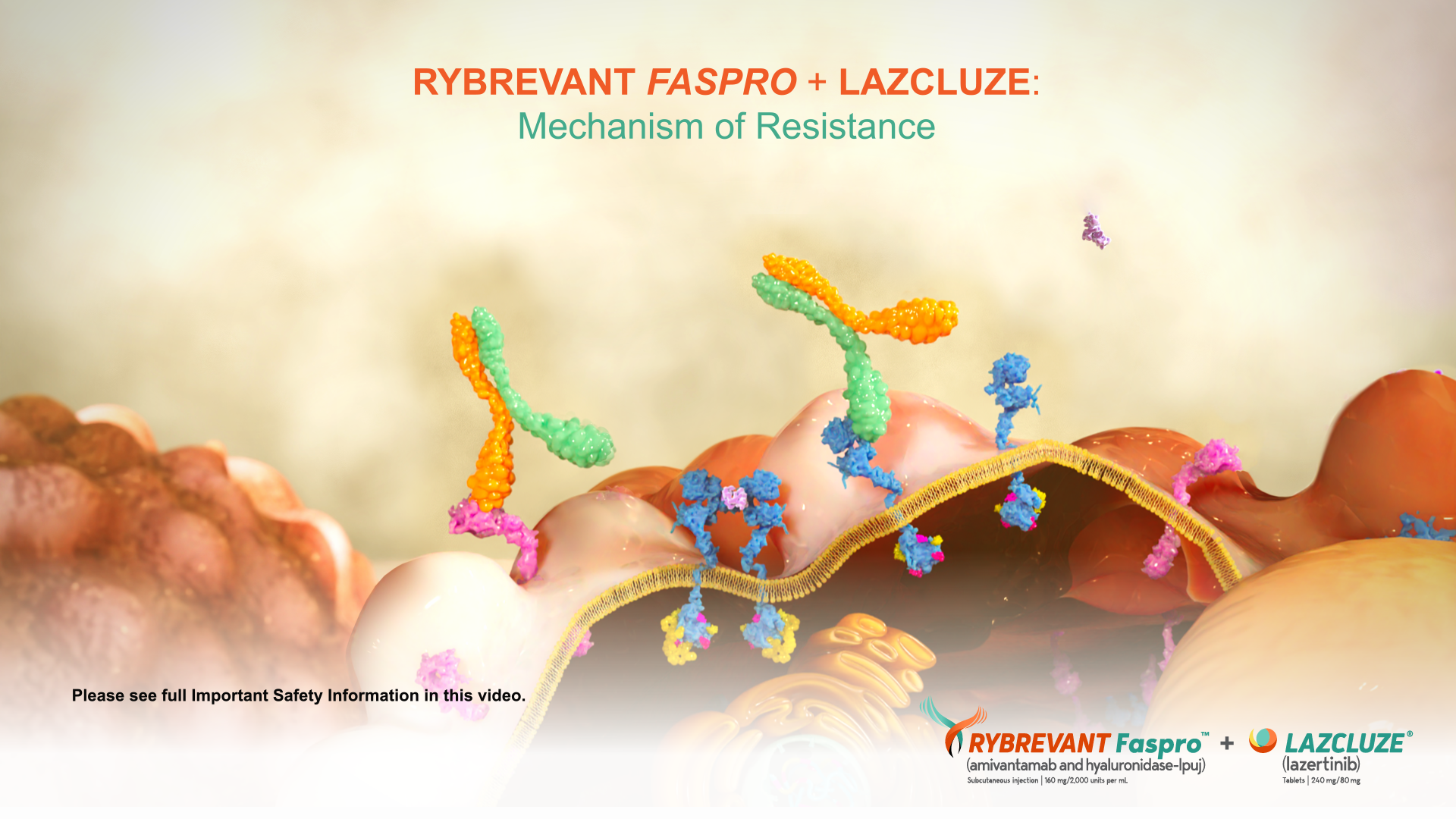
EGFR mutations and MET amplification are the most common mechanisms of resistance among patients taking EGFR TKIs.4-6

2L, second-line; AR, adverse reaction; MET, mesenchymal-epithelial transition; PFS, progression-free survival; TKI, tyrosine kinase inhibitor.

References:

  1. RYBREVANT FASPRO [Prescribing Information]. Horsham, PA: Janssen Biotech, Inc.
  2. Zhou F, Guo H, Xia Y, et al. The changing treatment landscape of EGFR-mutant non-small-cell lung cancer. Nat Rev Clin Oncol. 2025;22(2):95-116. doi:10.1038/s41571-024-00971-2
  3. Bazhenova L, Minchom A, Viteri S, et al. Comparative clinical outcomes for patients with advanced NSCLC harboring EGFR exon 20 insertion mutations and common EGFR mutations. Lung Cancer. 2021;162:154-161. doi:10.1016/j.lungcan.2021.10.020
  4. Passaro A, Jänne PA, Mok T, Peters S. Overcoming therapy resistance in EGFR-mutant lung cancer. Nat Cancer. 2021;2(4):377-391. doi:10.1038/s43018-021-00195-8
  5. Fu K, Xie F, Wang F, Fu L. Therapeutic strategies for EGFR-mutated non-small cell lung cancer patients with osimertinib resistance. J Hematol Oncol. 2022;15(1):173. doi:10.1186/s13045-022-01391-4
  6. Yu HA, Kerr K, Rolfo CD, et al. Detection of MET amplification (METamp) in patients with EGFR mutant (m) NSCLC after first-line (1L) osimertinib. J Clin Oncol. 2023;41(16 suppl):9074.
  7. Yang JC, Lu S, Hayashi H, et al; MARIPOSA Investigators. Overall survival with amivantamab-lazertinib in EGFR-mutated advanced NSCLC. N Engl J Med. 2025. doi:10.1056/NEJMoa2503001
  8. Cho BC, Li W, Spira AI, et al. Enhanced versus standard dermatologic management with amivantamab-lazertinib in EGFR-mutated advanced NSCLC: the COCOON global randomized controlled trial. J Thorac Oncol. 2025:S1556-0864(25)00939-6. doi:10.1016/j.jtho.2025.07.117
  9. Nieva J, Karia PS, Okhuoya P, et al. A real-world (rw) observational study of long-term survival (LTS) and treatment patterns after first-line (1L) osimertinib in patients (pts) with epidermal growth factor receptor (EGFR) mutation-positive (m) advanced non-small cell lung cancer [ESMO abstract 1344P]. Ann Oncol. 2023;34(suppl 2):S774.
  10. Lee JY, Mai V, Garcia M, et al. Treatment patterns and outcomes of first-line osimertinib-treated advanced EGFR mutated NSCLC patients: a real-world study [IASLC abstract EP08.02-082]. Presented at: IASLC 2022 World Conference on Lung Cancer; August 6-9, 2022; Vienna, Austria.
  11. Girard N, Leighl NB, Ohe Y, et al. Mortality among EGFR-mutated advanced NSCLC patients after starting frontline osimertinib treatment: a real-world, US attrition analysis. Presented at: the European Lung Cancer Congress; March 29-April 1, 2023; Copenhagen, Denmark. Poster 19P.
  12. Hayashi H, Besse B, LS-H, et al. Mechanisms of acquired resistance to first-line amivantamab plus lazertinib vs osimertinib: updated analysis from MARIPOSA. Presented at: IASLC 2025 World Conference on Lung Cancer; September 6-9, 2025; Barcelona, Spain.
  13. Spira AI, Paz-Ares L, Han JY, et al. Preventing infusion-related reactions with intravenous amivantamab–results from SKIPPirr, a phase 2 study: a brief report. J Thorac Oncol. 2025;20(6):809-816. doi:10.1016/j.jtho.2025.01.018